Educational, Grief, Pespective |

It’s not uncommon, as a griever, to come across literature or social shares that use the following common grief labels:
- Disenfranchised Grief (ambiguous) – a loss described as being one where someone experiences a loss, however, others don’t acknowledge the importance of the loss in the person’s life. Some examples may be the death of an ex-spouse, a pet, or a co-worker. This label is also used to describe the kind of grief you have when caring for someone who has dementia or lack of physical abilities (i.e., they’re present physically but not otherwise).
- Complicated (Traumatic or Prolonged) Grief – becomes severe in longevity and significantly impairs the ability to function. Warning signs from someone experiencing Traumatic Grief are described as self-destructive behavior, deep and persistent feelings of guilt, low self-esteem, suicidal thoughts, violent outbursts, or radical lifestyle changes.
- Anticipatory Grief – described as grief that a caregiver, for example, may experience once someone you love gets a significant diagnosis or the health of a loved one begins to deteriorate. Additionally described as the loss of the future you thought you would have or could’ve had with the loved one.
There are many others, including but not limited to: chronic grief, cumulative grief, distorted grief, exaggerated grief, collective grief, abbreviated, or absent grief.
My thoughts on all of these labels? They’re just that – labels – like “Betty Crocker” or “Pillsbury.”
GRIEF IS GRIEF
That’s all there is to it. Regardless of the loss experienced, the timeframe in which it happened, or how long it’s been since the event took place – all loss equals one word = grief. There need not be any fluffy words put in front of it. There need not be any labels placed on you as a griever to help you “understand” what you’re feeling. You already know what you’re feeling. These labels do nothing to lessen the blow, the pain, or the duration of the pain.
These labels actually drive me a little nuts. And, it is some of the most highly educated people who adopted or created these labels (such as anticipatory grief). And, many more highly educated people continue to apply these labels to grievers, too. If every highly educated adult in mental health read the book, The Grief Recovery Handbook, they would understand that labels aren’t necessary. And, in fact, they would also understand that they can actually do more harm than good. Also, they’re simply unhelpful.
So, as you go through the rest of the Covid sh*t-storm, have maybe even said goodbye to a loved one because of it, understand that your grief doesn’t require a label to be felt or understood. In fact, for the grief in others to be understood, we must first understand our own. Even those that create and write these labels, likely don’t understand their own. Because if they had, they would know there’s only one label for what you’re feeling – and it’s not a label at all – it’s an emotion in and of itself.
Also, I have no doubts that someone, desiring a name for themself, will conduct some sort of Covid-19 grief research and create a new label as a result. When this happens, which it will (call it a premonition), refer back to this blog post as it is written, this the 27th of November, 2020, that I say:
Grief is grief. It is an emotion that requires no other label.
Wrapping you in love and light.

P.S. What do you think? Have you found labels like these unhelpful? Share your thoughts in the comments. And, if you enjoyed this post, please share it with a griever you know that may need to hear that grief is a normal and natural response to a loss of any kind – any other label is just that. If you need help you can contact me and see how I can help or you can visit The Unleashed Heart site for more details.
Growth, Living Unleashed, Mind/Body Wellness, Pespective |
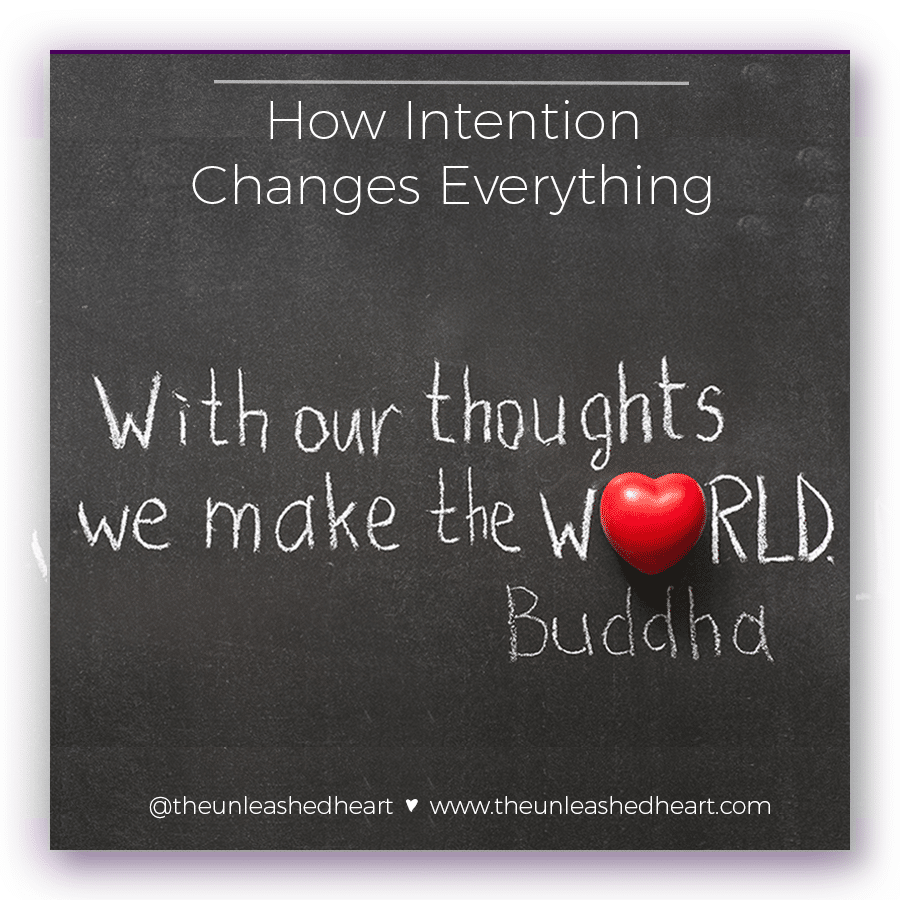
Intention isn’t something we often give, well…our attention. However, if we give it a little thought (and a little love), bizarre and synchronistic things can come about as a result.
This point was recently made apparent to me in a conversation I had with a friend. She wasn’t too thrilled about an upcoming situation, and I asked her how we could reframe her perspective. I told her rather than going into it thinking about where you’d rather be and all hum and drum and doom and gloom, think of the opportunity that is there to share your light. Just be you – because you never know who needs to hear what you have to share and what opportunities will come out of it. I told her to set the intention for what she desires before she even goes. And I was thrilled when she shared that it went even better than she imagined!
I had this happen to me many times over as well. You see, it’s easy to think of the worst-case scenario. It’s easy to project what we think will happen in the future. But, if there’s one thing that energy work has taught me is this: our thoughts have energy. And, when we set an intention of “it’s going to be horrible” before the word “go,” then guess what – we’ll probably get what we intended.
What if, instead, we took a few moments to put a different energy into a situation? What if, instead, we took a few minutes to envision how we prefer a situation to go and see it play out in our minds before we go into the situation? What if, instead, we set an intention for our entire day? What a concept, right?
Some may call this manifestation. I prefer to view it as intention, which makes me feel like I am playing an active role in creating a life I desire. Kind of the whole point of living, isn’t it? To bring our soul’s purpose, a life of fulfillment, and the best of who we are to everything we do and everyone we know?
Think about it. What energy have you brought into a situation before you went in and how accurate were you on the result? I bet you were pretty accurate – whether your mind went with doom and gloom or intended joy. I can think of so many situations in my own life where this has accurately played out. No matter which way I slice it, it comes back to the energy I was putting into the situation before it even played out.
This is the key to manifestation; feeling into the intention of what you desire.
Work on this one thing this coming week. If there’s an uncomfortable conversation, situation, or experience ahead that gives you some feelings of ick in your heart and mind, then do this one thing. Set aside some time every day, or replay your desired outcome in your mind as often as possible, leading up to the upcoming conversation/situation/experience, and let it go from your mind, all the while holding the energy of the experience you desire to have instead.
If you do this, please let me know how it goes! I love hearing these kinds of stories; they make me smile!
I’m reminded of this quote by Henry Ford:
Whether you think you can, or think you can’t, you’re right.
So too, whether you expect doom and gloom or joy, you’re right.
Food for thought this Friday.
P.S. Sports have been put on hold for my kiddos for a time. Do you know what that means? More availability for Reiki sessions! Check out my schedule HERE for availability. I had a bunch of sessions snatched up this morning, and there are still TWO Saturday Slots open on Dec. 5th!
Educational, Grief Tips, Mind/Body Wellness, Resources |

Have you ever felt overwhelmed, like the path ahead of you is too long and rocky to even contemplate, let alone to venture down? If so, you’re not alone. We’ve all felt like that, and it is a normal part of the recovery process. Being overwhelmed isn’t a failure! It is your body and mind telling you to slow down, take deep breaths, and approach each day one at a time. In these anxious times, sometimes the big changes that need to happen in your life aren’t ones you’re able to face right now. Instead, it can help to focus on small changes – minuscule changes – to start shifting your mindset and shape the life you want to live.
Think One Positive Thought
One brilliant exercise to kickstart your mental recovery is this: think one positive thought each day, ideally in the morning. You’re not trying to force your brain into positivity and light, but simply offering it one nugget of goodness every day. Try writing them down in a journal so you have a solid record of your progress. These thoughts can be incredibly simple. For example ‘it’s sunny outside’, or ‘I’m lucky to be alive’, or even ‘I had a tasty brownie and that was good’. This might seem small, but it is a tiny way to start thinking differently about the world, and that can have lasting consequences.
In his book, Love Yourself Like Your Life Depends On It, author Kamal Ravikant shares a method he used, while on the brink of suicide, to turn his life around. It started by taking 10 deep breaths every morning and evening before bed. However, it’s not simply a breathing exercise; as he breathes in he says to himself “I Love Myself” and as he exhales, he releases whatever needs to be released.
I don’t know if we can gratitude our way out of deep grief or depression. However, I do believe that actively flexing our optimism muscle by means of our thoughts, sets a strong foundation for the changes we wish to create in our lives. Because, when the going gets tough, we have a choice to either let our thoughts downward spiral us into worry and fear or keep us grounded in hope. And, because our thoughts play a pivotal role in the mind-body connection, our thoughts greatly influence our health, too. If you’ve never read Loise Hay’s book, You Can Heal Your Life, I highly recommend it if you’re dealing with health concerns.
Your Appearance
Have you ever had a haircut and felt on top of the world? Small changes to your appearance can have a major impact on your feelings of confidence and self-worth. It’s not shallow, it’s part of being human, and it’s time to embrace that. Find one small way you can treat yourself and let yourself know that you are valued and beautiful. This could be a fresh haircut, a facial, or a nice piece of clothing. If you wear glasses, how about finding a store with a big selection and picking a brand new pair that makes you feel effortlessly stylish? It can be anything, whatever works for you, as long as it gives you a small feeling of joy in yourself.
When I think back to when I was having my mid-life unraveling, I recall that self-care was not my priority. I would go three days without showering. I did not have self-care on a pedestal. And, it’s amazing how a shower can feel like a reset in your day. Put some intention into your self-care, including your appearance, and it shifts something inside you.
See One Friend Every Month
Grief can do strange things to a person; it can make you withdraw, and make it much harder for you to connect with other people. This has a domino effect, and finding a way back into the world is easier said than done. Immediately reentering large social situations may feel simply unfeasible. It’s important that you don’t put too much pressure on yourself, as this can lead to stress and therefore backward steps. Instead, commit to one small social act, for example, seeing a friend for coffee each month. This can be the same friend, or you can cycle through your social circle: whatever works for you. The vital part of this is that you are giving yourself time to recover whilst gently encouraging yourself into good habits. Your friends will understand, and they will also be delighted to see you and spend time with you.
Now is a great time to add in some small things to your day to improve your mood, given the current times. I send you loving thoughts as you navigate all of the changes you are facing, and when you’re having a rough day, it’s normal and natural to feel all the things. There’s nothing wrong with you. The question is, how long do you want to reside in “Gloomville?”
Some days, it’s going to take effort to shift your thinking, take a shower, or visit a friend – this is true. However, the days you decide to choose YOU, is already an act of rebellion against the monster of negativity looming over you – and all of us. Light your light shine bright, friend, and start within – someone else next to you may need it.
Educational, Mind/Body Wellness |
Taking a holistic approach to your health means looking at yourself as a whole person. Health problems are often not just isolated issues, and different aspects of your health can play into each other. One simple example of this is that you’re not feeling very well because you have a cold. You might not be in a perfect mood, either. One health issue can affect others, leading to more problems that all need to be addressed. When you take a holistic approach, you can make sure that no stone remains unturned to keep you healthy. If you want to take a holistic approach to your health, here are some of the things you can do.
Pay Attention to Your Diet
Regular exercise is important for staying healthy. However, it’s not the only thing that you need if you want to keep fit. Your diet is also important for your health, whether you want to lose, gain, or maintain weight or get all of the nutrients you need. Your diet plays an important role when you’re trying to recover from illness too. You can read an article where American Addiction Centers reviews the importance of nutrition in substance abuse recovery. When you’re eating the right things, you give your body the fuel it needs to get better.
I am, by no means, perfect in this area. I’m on the food struggle-bus a lot. We don’t have access to many fresh foods like those in bigger cities, and boy, trying to get my carb-loving family to take the initiative to cut a celery stick and dig out the peanut butter is nearly impossible unless I set it out in front of them. Anything that takes effort in my home for my family is probably the biggest challenge in making better choices. And, I suppose, if the carbs aren’t brought into the home, they’re not there to be eaten. We easily become lazy in this department, as many people do. When I say “lazy,” I mean it in a way that it takes effort to choose, purchase, and eat more wisely.
Perhaps it would be good for me to look at my food story growing up for insight into this, too. Growing up, carbs were the cheapest thing to buy. I did not grow up eating balanced meals. And that, my friends, is a hard habit to break. Something to work toward for sure – healing that food story. Do you have a food story? I bet you do if you’re on the food struggle-bus. Just las we all have a money story, we all have a food story, too.

Care for Mental Health
The mind-body connection is one of the key things to pay attention to if you want to take a holistic approach to health. Your mental health and the way your mind works can affect your physical health, and vice versa. When you have physical health problems, it can affect your mental health for various reasons, whether it’s because something in your body affects your mood or because the change in your life is getting you down. Poor mental health can lead to less care for your physical health too. That’s why it’s essential to take care of both together.
I also lean toward the belief that our bodies respond to what’s going on in our minds and the thoughts we are most focused on in our lives. If we’re focused on the doom and gloom of life, we’re likely to behave as if life is doom and gloom, and there’s nothing to be joyful about, right? Likewise, if we put our thoughts on a pedestal and truly pay attention to what we’re telling ourselves throughout the day or all of the problems we’re focusing on – we can see that those thoughts are likely harming our bodies.
This is what grief does to us. It swings the pendulum of joy in the opposite direction, and we must work daily to find balance. We must not neglect the sad, angry, or fearful feelings; rather, we must feel them heal them, so they do not consume us.
Use a Health Tracker App
Keeping a close eye on your health and the healthy things you choose to do can help you feel a sense of control. A health tracker app, perhaps paired with a wearable fitness tracker, is a great way to put yourself in control of your health. It can help you to get an overview of different aspects of your health, from exercising and your diet to practicing meditation and mindfulness. Different apps will offer varying features that might come in handy.
I personally wear a Garmin. I wanted a tracker that looked more like a watch. Before I gave up alcohol, my Garmin showed me how it negatively impacted me for up to 12 hours after. It was fascinating to see how consistently alcohol was adding stress to my body. I also see the same spike in stress during sleep when I’ve been gone shopping for a whole day. Crowds, lines, and shopping, in general, are not things I enjoy and are taxing to my energy. Another stat I’m able to monitor is how my cycle, step count, and so forth impact my sleep and stress throughout the day. I have found the Garmin to be very accurate, too, compared to my count when I’m on my treadmill. Using a health tracker for insight into your health is a great place to start. However, when you’re utilizing it to obsess over your step count, as I did years ago when I first got a FitBit, it is counter-productive to your mental health and overall well-being.
Find the Right Doctor
If you want to take a holistic approach to care for your health, it’s also a good idea to find a doctor who will do the same. Whether you’re looking for a primary care doctor or trying to find the right specialist, you need someone who will treat your whole person, rather than zeroing in on specific problems or symptoms and disregarding other factors.
I recently was referred to a naturopath, a good friend who shared an educational video on hormones and how she approaches hormones holistically. It was eye-opening to me. I wish I could share it but, it was shared with my friend’s private community. This naturopath indicated that a female’s spit should be used to show accurate hormone levels. They should be taken throughout the duration of a menstrual cycle to determine when any hormone dosage needs to be adjusted. She added that our hormones are directly related to our liver and tied to all bodily functions. So, hormones are pretty darn important. If you haven’t heard of “fatty liver,” look it up. Now, imagine how “fatty liver” is impacting your hormones and your entire body!
To take a holistic approach to your health, you need to consider every part of yourself. It’s also helpful to have support from health professionals who will do the same.
Educational, Grief Tips, Grieving Voices Podcast, Growth, Living Unleashed, Mind/Body Wellness, Pespective |

Do you like to play dodgeball? You know, the game where balls are thrown at you with the goal of getting you out of the game? And, you hope that you don’t end up with a bloody nose by the end of it?
Imagine your thoughts being the ball and your heart and physical body are on the receiving end. And, consider how many times during any given day you are the one throwing the insults in the direction of yourself.
The most important conversation we need to have when we do this is not in our heads. Rather, the most important conversation we need to have in moments like this is the one we have with ourselves and with our hearts.
We have more than 6,000 thoughts in a day, according to a study conducted by researchers at Queen’s University in Canada. Also, according to the study,
Anxious or racing thoughts, negative self-talk, worry, and overthinking are hallmarks for people who know the challenges of dealing with mental health diagnoses like anxiety and depression. These conditions affect a growing number of Americans.
- Anxiety disorders affect 1% of people in the U.S., making it the most common mental illness.
- According to the Anxiety and Depression Association of America, “anxiety disorders develop from a complex set of risk factors, including genetics, brain chemistry, personality, and life events.”
I’ve been reading the book, “Love Yourself Like Your Life Depends on It,” by Kamal Ravikant. In it, the author shares how he turned his life around by using a self-love practice, which he found by doing more of what made him feel better. At the core of this practice is telling himself every single day, throughout the day, that he loved himself. I’m not quite half-way through the book, but so far, my takeaway is that this book reinforces what I learned through grief recovery, and that is: We can’t heal the heart with the head. We certainly don’t heal the heart either by all the garbage we tell ourselves on a daily basis. All this does is reinforce the beliefs we have about ourselves, thereby, reinforcing the repeated patterns of behavior that keep us stuck in our lives.
So, I’ve been working on implementing my own “self-love” practice, and it does include principals taught in this book. Along with the other healing modalities I have learned along the way (grief recovery education and the practical tools it provides along with reiki), I feel like I am leaving 2020 more emotionally resilient than how I came into the year. Also, far more prepared for whatever 2021 may bring, too. I’m working on changing the conversations I have with myself.
The majority of us have spent years in self-loathing. The opposite of self-loathing is self-love. And, it’s a sport most of us need a lot of practice in, in order to see our hearts transformed. The timing of coming across this book is uncanny and very synchronistic. So, I’m fully embracing it and trusting that it’s a part of the process I’m ready to dig into for my own healing.
If you desire change in your life, it starts with the most important conversation you need to have – the one with yourself and your heart. When was the last time you asked your heart what it needs?
This year, I learned this from a mentor, and I keep a post-it with this written on it, above my desk, where I see it every single day.
I am where my attention is.
 Who would I be…
What would I do…
and
How would I feel if I already had…
Where do you want your attention to be as we bring 2020 to a close?
Where do you want your attention to be in 2021?
Healing is my jam. To bring my best light and my best self to the work that I do, I need to work on clearing out my own gunk. Put another way, as Kamal Ravikant mentions in his book, I need to keep bringing out the rag and clean my windows.
Maybe you’re not looking to be a healer-type person. That doesn’t matter. Because I would bet that what you really want is to feel better and to live your best life. Am I right?
Start within and listen to the guidance of your knowing heart.
P.S. We start by asking ourselves better questions. If you’ve never listened to my podcast, Grieving Voices, the first 12 episodes are a great start! You’ll be doing all sorts of reflecting and asking yourself all kinds of questions as you listen. Take it one step further and grab a notebook and pen and put your thoughts on paper. We can turn our screams into whispers…trust me. (Side Note: “When Screams Turn Into Whispers” is a book title for someone I interviewed for the podcast recently – such a great episode on bipolar disorder that I can’t wait to share)
Childhood Grief, Grief, Grief Stories, Growth, Pespective |

Have you seen the Netflix Series, Cobra Kai? It’s a follow-up comedy-drama to the characters of The Karate Kid, the coming of age movies from the 1980s.
My husband had started watching it, and not intending to, I actually got into it myself. It’s actually pretty funny at parts, but too, is relatable as many of us grow up not being the popular kid in school. Many kids also have parents who shoot down their dreams; even parents that take it further and put them down.
Watching the show inspired this blog post, along with many of the conversations I’ve been having lately with grievers for my podcast, Grieving Voices.
Grief is the loss of hopes, dreams, and expectations.
Over the past couple of months, I’ve heard stories of all kinds of loss. The one common thread through many losses is the loss of hopes, dreams, and expectations.
Whether it’s been a career you didn’t chase, a degree you put on the back-burner, a child born with special needs, or chronic illness that has taken over every aspect of your life – there is a loss of hopes, dreams, and expectations.
Which is…what again?
GRIEF!
The Cobra Kai series takes the viewer back to the character’s “glory days,” past and present decisions made, and experiences in the present that cause “flashbacks” if you will. We all experience these moments as adults. As kids, many of us have felt, at one time or another, that our lives were meant to go a certain way based on our current reality, or we had some sort of expectation (or hope) of how life would turn out.
As a kid, I wasn’t coordinated. I did not have athletic ability. As I’ve watched this series, I related to the kids who had been picked on and had my own flashback moment. Even watching the latest season of Bachelorette, where Clare shared how she was teased as a kid, is something that has stuck with her and, I resonated with her story. There are a lot of hurting people out in the world hurting people by being bullies. And, bullies aren’t just on the playground. They’re by the water cooler, in the public restroom, at the checkout line, sitting in the cubical next to you, or maybe even in your own home.
I am not making this blog post out to be a pity-party. I’ve learned to flip that script. I feel strong in body but more importantly, far stronger in mind – mentally and emotionally. But, what if you don’t?
Were you an insecure kid? Or, did you start out with confidence but then life-experiences later in life change all that?
How do you repair the feelings associated with a loss of hopes, dreams, and expectations (i.e, grief)?
The action steps of doing just that are what we do in grief recovery.
Don’t let grief that originated from the past dictate your future. Do you want to put 2020 in the rearview and begin 2021 with an emotional clean slate? Email me about how I can help you go into 2021 by shedding the layers keeping the authentic you hidden behind the loss of hopes, dreams, and expectations.
Childhood Grief, Death/Dying, Educational, Grief, Growth, Pespective, Resources |

 Do you believe that you are forever going to feel sad, isolated, or in your current circumstances?
Do you believe that others have their lives figured out and don’t understand how you feel?
Does it feel true that who you thought you were has been upheaved and that you’ve been shaken at your foundation?
Six years ago, I embarked on a path of some deep excavation. It’s often been painful, but I have found that the excavating hasn’t been nearly as painful as the emotional dis-ease I had been feeling. With each passing year, I’ve learned how to be more conscious of my thought process, actions, and it’s gotten a lot easier to recognize when I start down an emotional tailspin. It’s gotten so much easier to snap out of it, too. Whereas, years ago, circumstances and my internal emotional climate would have derailed me for weeks. When you’ve had your entire life to form your beliefs and behaviors through experience and circumstances, it becomes a project of rewiring your brain and creating new connections.
I held those beliefs I shared previously. I felt I was destined to feel crazy for the rest of my life. Back then, it was a program that helped me snap out of it. In 2014, I discovered Tony Robbins. Through his work and the inner-work, I started to get sick of my own self. I started to learn new ways of BE-ING. I started to ask myself deeper (and better) questions.
Finding our way to our best selves, the heart of who we’ve always been isn’t a complicated process. But, it does take time, and it does take commitment to yourself. When I say it takes time, you don’t have to spend hours a day every day of the week. Starting small is still a start. Whether you incorporate one thing into your daily life, such as journaling, meditation, yoga, a daily walk (to think and let your mind go or listen to insightful/inspiring podcasts), or a simple breathing practice (which is actually more challenging than meditation for me), another option is to add in a regular Reiki Guided Healing Meditation session (followed by receiving reiki). This is a powerful session (60 or 90 minutes) that takes you to a depth of self that you have likely never experienced. And, after next weekend, I’ll be able to offer an even more elevated Reiki session after I complete my Usui Karuna Holy Fire Certification.
If you’d like to dig into the depths of heart even more deeply (and with an end date of the work you’ll do that is proven to provide results), we can work together online. You may feel that grief recovery isn’t for you. However, ask yourself how many losses you’ve had.
Do you want to discover losses that may be holding you back in your life? Below, I have a questionnaire that will help you discover what may be keeping you tied to the past. I provided this document at speaking events, and it helps understand how grief isn’t just about death. You’ll receive the download immediately!
[et_bloom_locked optin_id=optin_9]https://theunleashedheart.com/wp-content/uploads/2020/10/GRM-Questionnaire_vv.pdf[/et_bloom_locked]
I want you to feel hope, more than anything. For years, I had lost it, and I know the impact that had on my spirit. There is help, and there are resources out there. Know that you are worth the investment in yourself.
 What is emotional freedom, feeling aligned inside, and having a deeper understanding of your past, so the same beliefs and behavior patterns don’t repeat themselves – worth to you?
Here for you – always.
Educational, Growth, Pespective |

This week’s newsletter I sent out on Wednesday was about boredom. I thought I would go a bit more into depth on the topic here on the blog.
The one phrase you will never hear me say is…”I’m bored.”
I don’t know what boredom is. Even as a kid, I always found something to do. On the flip-side of not having anything to do, I don’t feel bored when I find myself just “BE-ING.”
 When was the last time you allowed yourself to BE?
My response to my kids when they say they’re bored is the same every single time: “Don’t tell me you’re bored because I’ll find something for you to do!” There’s always something that can be cleaned, organized, or whatnot when you have a home.
How often do you think about there being nothing to do and feel bored?
Here are some questions to ask yourself when you feel bored:
- How would I rather feel (Inspired, Creative, Joyful, Accomplished)?
- What am I curious to learn more about?
- Why do I have a hard time being still and present?
- What is one thing I’ve never tried but always wanted to?
If you consider all of the possibilities and opportunities that await you daily, boredom wouldn’t even enter your mind.
Follow what makes you curious.
Rather than mindlessly watching tv out of boredom, or scrolling all of the Facebook drama (which neither of these serves your highest good), look within to see what it is you wish to discover or learn about yourself or begin the practice of just BE-ING still with yourself. One of my favorite things to do during the warmer months is sitting outside early in the morning and listening to the birds serenade me. I feel such peace. And nowadays, who couldn’t use more of that?
In this article by the American Psychological Association, it says:
There’s even evidence that the phrase “bored to death” has some truth to it. As part of the Whitehall II Study, begun in 1985, British civil servants answered questions about social determinants of health, including some questions about boredom. More than two decades later, Annie Britton, PhD, and Martin Shipley, PhD, compared their responses with death records. They found the people who reported experiencing a great deal of boredom were more likely to die young than those who were more engaged with the world (International Journal of Epidemiology, 2010). The researchers theorize that boredom was probably a proxy for other risk factors, such as drug and alcohol use. Boredom is also associated with performance detriments, which in some cases can lead to serious problems.
“We know when people are bored they’re more likely to make performance errors and likely to not be as productive,” says Eastwood. “That’s a big deal if you’re an air-traffic controller or you’re monitoring a nuclear plant.”
On the other hand, boredom can prompt people to move out of tedious routines. Belton recently interviewed people known for their creative success, including an artist, a novelist, a poet and a neuroscientist. “They all said boredom can instigate new thinking and prod them into trying new things,” she says.
The poet took up his craft in middle age after finding himself stuck in a hospital bed for several hours with nothing to do. The only paper he had available was a stack of Post-It Notes, so he began writing poetry, the most practical activity to fit on three square inches.
“If people don’t have the inner resources to deal with boredom constructively, they might do something destructive to fill the void,” Belton says. “Those who have the patience to stay with that feeling, and the imagination and confidence to try out new ideas, are likely to make something creative out of it.”
The last paragraph above, from that blog post, is the premise of this blog post today. Use boredom to your advantage; take the time to BE, or use it as fuel to follow your curiosity in life. And, ask yourself if you are feeling bored if you’re looking for or needing something to fill a void you’re feeling in your life.
I have days where I binge-watch a show. Particularly on days when I’ve had a week where my mental bandwidth was pushed to the max and needed to let my mind go, meditation is great for this, too, of course, but I do get where sometimes you need just to let your mind go and prefer to do so in an entertaining way. However, if we ask ourselves if I’m bored because I’m avoiding a greater issue at play internally or am seeking out an outside fix to fill that internal void – that’s where we are given an opportunity.
If You Have the Opportunity to Be Bored, You Have the Opportunity to Grow
The opportunity is what this post is about, too. We are given opportunities to grow daily, because, if we’re in relationships with people, there’s always something to learn. Our relationships, and the substance of those relationships, are a mirror and reflect us where we’re living in our authenticity or where we’re operating out of a place of fear.
So, the next time you’re bored – perhaps, it is just that. But, I challenge you to think outside of the state of being bored and into a state of a more effective and self-serving way to use your time. What is something you’d like to learn about yourself? What do your dreams mean? What location sounds interesting to explore? Where are there opportunities to grow – physically, spiritually, emotionally, and mentally?
The best question to ask ourselves is how we waste our own time – which is the most precious commodity we all have. And, for being a society which relishes on the idea of never having enough of it, there shouldn’t be anyone saying they’re bored. And, on the flip-side, perhaps people aren’t allowing themselves to get to that state in the first place? Where they ask themselves the very questions, I posed in this blog post. Hmmm…getting deep…
I would be remiss if I didn’t weave this somehow into grief. Those who do not have the luxury of being bored because they are a caregiver to someone ill (physically or mentally) or dying are thrown into growth territory they didn’t ask for whether they like it or not. Experiences like these leave imprints on our hearts and sometimes, not the best of ones. So, for those of you who are a caregiver, I’m not going to sit here and tell you to find time to get bored. Rather, maybe the best thing you can do for yourself is to create some space in your day to reflect. Celebrate where you showed compassion, empathy, and care so selflessly. Acknowledge the fact that you are being an expression of love to someone else. And, for those of us who are not in the position of caring for someone ill/dying, may we consider that boredom is a luxury and it’s time to utilize our time for good – of improving ourselves or the lives of others.
What say you? Do you find yourself frequently bored? Or, do you wish you actually had the “luxury” of being bored?
I guess how you answer is a reflection of how you view time itself. And, the impact you wish to leave on the world.
Grief Stories, Growth, Living Unleashed, Pespective, Spirituality |

Piece by piece, the puzzle of ourselves starts to come together. For many, it doesn’t begin until mid-life. For the lucky, it happens much sooner. Although I don’t believe it’s luck—instead, several things like awareness, a desire, and synchronicities that unfold in perfect timing.
Personal growth and development have been a life-long mission of mine. It wasn’t until the last couple of years, where I’ve sought personal development as a means to function at a higher level in my life. Up until a couple of years ago, the driving force was to gain an understanding of what was wrong, needed fixing, or just written into the D.N.A. of who I am. In truth, I have been on a quest to know myself since I was a child when I had an interest in understanding and researched the lines on my palms (I have a single palmar crease on both hands if you’re wondering what had me so intrigued about my hands).
If you’re like me and are kind of like a personal development junkie, do you seek knowledge to fix, or do you seek knowledge to grow? The goal will definitely change the process. Why? Because, if also like me, you intended to fix what you believe to be wrong with you, then you’ll always be spinning your wheels. You’ll never arrive at this all-knowing place and meet a level of satisfaction with what you’ve learned. That is until you pursue knowledge to grow and follow it up with action.
In full transparency, and as I’ve previously mentioned, I’ve been hitting personal development hard since 2012 – about a year into having my first business. Entrepreneurship, it seems, brings a lot of ghosts out of the woodwork. I started to see the shadow-side of me coming out around 2014. And, that’s when the unraveling began.
And truthfully, it wasn’t until today that I connected some dots for myself in why I’ve struggled with consistent creation in my life (of what I want my life to look like). Coincidentally or not, I don’t know, but while pregnant with me, my mother drank. Back then, it wasn’t unusual, I guess (?), to put 2 oz. of beer in the bottle to get me to sleep. I am told, “it’s what we did back then.” Not surprisingly, I had to stay in the hospital after I was born for several days because I was jaundice. I also was apparently due on February 14th, and didn’t arrive until March 5th and still only weighed a little over 6 1/2 pounds. Again, obstetrics were not then what they are now. But, it helps to paint a picture that, before I was born, I was suffering. And that’s the dot I connected today. It’s all I’ve seemed to know. It’s the one emotion I have been working to transmute my entire life into something meaningful, which brings me to today and the continual unraveling. Like Patsy said in this podcast interview (and I’m paraphrasing) when you start to pull one thread, the unraveling begins. And so it does.
I pulled my thread of unraveling in 2014. However, it wasn’t until I went through the grief recovery program where I started to see the impact of that pulling I began five years earlier.
The process of unraveling continues for me, and it’s led to so many beautiful experiences and connections in my life. It led me to Reiki, which serves my curiosity and inspires me to continue to learn about energy (and whoah, have my eyes opened). I’ve continued to look for opportunities to continue to grow and expand my healing around relationships and complete education that will help me to serve others on a bigger scale (Online, One-on-One Grief Recovery, and Helping Children with Loss programs). And, I’ve found some incredible support along the way, too. These opportunities and people didn’t magically appear in my life. It all started with a strong desire to, like I said, transmute my suffering into meaning and serve a greater purpose in my life.
What I’ve also been learning is where I’ve been standing in my own way, which brings me back to the single palmar creases on both of my hands (which, by the way, one of my children also has and makes total sense to me #icanrelate) and what a palm reader once told me. She said these are gift lines. Yes, they have their challenges, but the gift is in intense focus and (along with my other “gift marker”) my ability to “deep dive” with people into their own emotions. In a nutshell, I was made for the work that I do. And, on days where I’m feeling discouraged, it’s been easy to forget that. On days where I feel like doing this work full-time is so far away on the horizon, I have to remind myself. Keep grinding. Keep showing up.
There is no one standing my way – but me. And, for whatever reason, I’ve felt this hard today. Ironically, I had not written this week’s blog post in advance, as I’ve always done. Perhaps this message is divine timing for you. That you, too, are the single denominator standing in your way. It’s not your circumstances (trust me; I live through my version of “suffering” each day). It’s not your physical health. We create these circumstances long before they become “problems.”
I have so much more to write on this, but I’m still unpacking this big a-ha I had for myself today. So, I’ll leave you with some wise words I came across today that struck me (because I’m in the work of feelings):
When feelings become the means of thinking or if we cannot think greater than how we feel, we can never change. To change is to think greater than how we feel. To change is to act greater than the familiar feelings of the memorized self.
Stay tuned to the unraveling taking place – in our world, our communities, homes, and within our hearts. There has never been a more keen awareness in recent years, for this collective understanding of what isn’t working, what we desire to change, and where we need healing.
You can look at the current times as a life sentence for more suffering or an opportunity to set your inner-most self free. I’m choosing the latter. You, too?
Have a wonderful weekend, and thank you for reading. If this resonates with you, I’d love to hear from you in the comments, on social, or via email. 🙂
Grief, Grief Tips, Growth, Living Unleashed, Mind/Body Wellness, Pespective, Reiki |

Have you felt like you’ve been on a rollercoaster ride, emotionally, lately?
I have.
My kids are now home due to COVID. So, aside from that, and all the other things come with life, work, and business, I’m tired. And, I know I’m not alone.
One thing that I’ve found that has helped me not to lose my marbles lately is taking at least 45 minutes every morning for myself. Every weekday, I do a workout. Periodically, I give myself Reiki. One day this week, I also journaled. The point is, taking time for my body, my heart, and my mindset has dramatically kept me from lashing out in frustration.
How often, though, do we go about our day without making our body, heart, and mindset a priority? How often do we lax on our self-awareness and go about our day mindlessly? A lot.
I recall many times throughout my life, where the littlest things would set me off. This response is not uncommon to us when we feel as if we’re on an emotional rollercoaster. So, how do you suppose this quick-to-anger, being easily poked by the bear – way of being is impacting your life, work, and business if you have one?
Back when I had my first business, I was struggling in a lot of ways emotionally. I was having physical symptoms, including unexplained body aches, headaches, and hair loss. Also, I had or have never been diagnosed with anxiety. However, since having a better understanding of our energy, I look back in hindsight and recognize that the physical angst I would often feel was anxiety. Even today, when my thoughts start to tailspin around overwhelm (which I’ve come to learn is due to lack of prioritizing) and the future, I begin to have episodes of heart arrhythmia and feel like I could jump out of my skin. Again, I don’t know if this is what anxiety feels like to those diagnosed, but this is when I know I am out of energetic balance.
I’ve come to understand that grief and energy go hand-in-hand. I do feel that is why Reiki found me after going through the grief recovery program and starting to unravel the years of emotional dis-ease I had carried.
When I look back on the years when I first joined the workforce at 14 and onward, I recognize (with new awareness) what emotional dis-ease (i.e., grief) has cost me. There were many jobs I never applied at because I didn’t feel like I had a snowball’s chance in you know what of getting the job. I also got so scared about the future, finances, and all the things when it came to college. I spent a weekend in a dorm when I turned 18 to pack the car and leave before ever giving myself a chance. I gave up on myself before I even tried. And, all because of fear and money.
I did not trust myself. I did not understand intuition and how to tap into it. I always looked to the external for affirmation that I was doing the right thing or looking for permission or just someone to tell me what to do. It was this confusion, and yet, also a knowing that I could do hard things that led me to join the military. If money was the problem in attending college, well then, I found my solution. What I didn’t realize was that I still had to pay that money upfront (which, I believe, is still the case).
I’ve learned to become resourceful through struggle, but I’ve also learned how to be resilient. That said, it’s taken me decades to dig in and tap into how to utilize my resourcefulness and resiliency. You see, when we’re emotionally suffering, it’s often difficult to see potential and possibility – in ourselves. Our minds become a fog of illusion that we’re okay and fine. However, if we take a birds-eye view of our life, we often see that we have blocks that keep us repeating the same self-sabotaging behaviors. Or, we become hyper-focused on performance, results, and outcomes – all the while neglecting ourselves and those we love (hello, burnout)!
Below is a rundown list of all the ways, I believe, emotional dis-ease creates blocks and hinders our progress in life and business. These are ways I self-identify with, and I am sure there are many more I haven’t thought of that I could add. If this list resonates with you, I’d love to hear from you! I’m curious if there are others I haven’t included that you found to be true for you?
The Ways Emotional Dis-Ease Impacts Life & Business
- self-worth issues
- questioning/second-guessing every decision or difficulty making decisions
- seeking outside validation/affirmation
- unable to see other perspectives
- lack of discernment
- physical symptoms
- money drama – money comes, money goes // lack of growth in account or savings
- quick to anger
- fractured relationships
- difficulty connecting with others
- feeling like others are out to get you // victim mindset
- trust issues
- lack of self-awareness or not conscious of your physical body // desire to “numb-out.”
- avoid important issues within life or business
- not sure what you value
- don’t see the value you bring to others
- lack mindset // inability to see opportunities
- difficulty focusing/concentrating
- procrastination // difficulty prioritizing & planning
The more of these that resonate with you, the more likely you’ve got some emotional weeds in your heart garden that need some tending and pulling. With each weed we pull, we’re clearing out space for more beauty to enter and unfold in our lives.
There is hope on the other side of all of this. I’ve been having some wonderful conversations with some incredible healing hearts for my podcast, Grieving Voices. And, these guests have proven this to me over and over. There’s no such thing as joy or sorrow – the two co-exist within a matter of moments of each other. However, when the scales tip further one way than the other in a way that doesn’t sit right with you, then you have a choice to do something about it.
There is no timeline for healing emotional dis-ease. However, how much time are you willing to give sorrow? How much of your life are you ready to gamble? We all reach a point where we get sick of our own crap. My friend, that’s when the magic happens. That fire in your belly for wanting more for yourself and your loved ones – it’s the stuff that dreams are made of, and we often give up on our dreams before we give ourselves a chance. We often don’t think there’s hope.
Take your life by the horns, my friend. It’s waiting for you. Will there always be painful and challenging things that put a boulder in your way? Of course. Life isn’t a fairy tale or movie. But, why write the final chapter before you’ve lived all the chapters in-between? Resiliency is learned through experience and growth, a by-product of suffering. I don’t care which way you slice it. It’s just some people are more willing to allow the unfolding than others. Fear and resistance keep the rest stuck in the past.
The future will not be found in the past. It took me 30+ years to discover this. That said, our pain often becomes our message. And, maybe that’s just a part of my walk here on earth. I don’t know. As a podcast guest stated recently, “I feel more awake now than ever.” And you know what, this woman lost her 17-month-old son suddenly. A loss I cannot even fathom. So, please don’t take it from me; tune in to the podcast and hear the stories of hope for yourself—just incredible stories I am honored to share with listeners. I feel so inspired by their faith and trust in what is possible for them. And, for a time (like myself), they didn’t see it for themselves, either.
There are gifts of grief (i.e., emotional dis-ease/suffering). Get empowered by what is possible, regain emotional control of your life (and body), and watch that list above fade into the rearview.
P.S. Need a lifeline of hope? Reach out to me. Here to serve and create more healing ripples in the world.
