Educational, Emotions, Grief, Grief Tips, Healing, Mind/Body Wellness |

Grief That Isn’t Death: You’re Still Allowed
Nobody dropped off a casserole.
There were no cards in the mailbox. No one checked in three weeks later to see how you were holding up. No one said “I’m so sorry for your loss” — because from the outside, it didn’t look like a loss.
But something ended. Something shifted. Something that used to be yours is gone now.
And you are grieving it — even if no one around you is calling it that. Even if you haven’t been calling it that.
The Losses Nobody Names
We’ve been taught — not loudly, just consistently — that grief belongs to death.
That it’s reserved for funerals. For the kind of loss that comes with a date you’ll carry forever.
But grief doesn’t work that way.
Grief is the normal and natural response to loss of any kind. And loss shows up in far more ways than we’ve ever been given language for.
The divorce was the right call, and it still broke something in you. The career that ended, taking your sense of purpose with it. The friendship that dissolved so slowly you almost didn’t notice — until one day you realized you hadn’t talked in over a year. The diagnosis that quietly rewrote the future you thought you had. The move that took you away from everything familiar. The dream you finally had to release. The version of yourself you had to leave behind to get here.
These are losses. Real ones.
And the grief that comes with them is real too — even without anything to point to.
Why “Good Change” Can Still Hurt
Here’s the part that trips people up most — and the part that can make you feel like something is wrong with you:
Sometimes the thing you’re grieving is something you chose.
The relationship you ended. The job you walked away from. The life chapter you closed on purpose because you knew it was time.
And yet — you’re sad. You’re grieving. And somewhere underneath it is a voice asking: Shouldn’t I just be grateful?
You can be. And you can also grieve it.
Gratitude and grief are not opposites. They don’t cancel each other out. You can be genuinely glad for where you are and still mourn what it cost you to get there.
Both are true. At the same time. In the same body.
That’s not confusion. That’s honesty.
When You’re Grieving a Version of Yourself
There’s a particular kind of loss that almost never gets named — and it’s one of the heaviest things I see in the people I work with.
It’s the grief of losing who you were.
The person you were before everything changed. Before the loss. Before the diagnosis. Before the relationship ended or the kids grew up or midlife arrived and quietly asked: Who are you now, outside of all the roles you’ve been filling?
That question can feel like the floor shifting.
Because when your identity has been wrapped around a role — a relationship, a career, a version of your life — and that role changes or disappears, something in you goes with it.
That something deserves to be grieved.
Not reframed. Not rushed. Not turned into a lesson before you’ve had a chance to actually feel it.
Grieved.
Stop Minimizing What You’re Carrying
If you’ve said any of these things to yourself, this part is for you:
💔“I shouldn’t be this sad — it was my choice.”
💔“Other people have it so much worse.”
💔“It’s not like someone died.”
💔“I just need to move on.”
Those are the things we say when we’ve been taught that grief has to earn its place. That it has to meet some threshold of tragedy before it’s allowed to exist.
It doesn’t.
Your grief doesn’t have to be the biggest grief in the room to be real. It doesn’t need to be compared, ranked, or justified.
The grief that doesn’t get named is the grief that gets stuck. And stuck grief has a way of showing up sideways — in your body, in your relationships, in the low-grade exhaustion you can’t quite explain.
You’re not being dramatic. You’re not weak. You’re not ungrateful.
You’re carrying something real. And real things deserve real support.
A Five-Sentence Goodbye
Here’s an invitation to practice for this week:
Write a five-sentence goodbye. To the season that’s ending. To the version of yourself you’re leaving behind. To the life you thought you were going to have.
You don’t have to share it. You don’t have to show it to anyone. You just have to say it — because the things we name lose some of their power to quietly undo us from the inside.
Five sentences. Imperfection is fine. Honesty is the only requirement.
The Grief That Goes Unnamed Is the Grief That Gets Stuck
The losses that never got named are the ones that accumulate quietly — in the body, in the nervous system, in the way you move through your days carrying a weight you can’t quite explain.
I’ve seen it in the people I work with. I’ve lived it myself.
You don’t have to keep carrying it alone. And you don’t need a “big enough” loss to deserve support.
If something in this post felt like it was written for you — it was.
→ Book a free consultation — let’s talk about what you’re carrying, what you’re grieving, and what moving through it could actually look like.
→ Explore the Grief Companion Kit — a self-guided resource for when you don’t know where to begin.
And if you’re not ready for that yet — start with the five sentences. Start with naming the thing you’ve been minimizing.
Start there.
Because the grief that finally gets named? That’s the grief that finally gets to move. 💛
____________________________________________________________________________________________________________________________
Every grief journey is different, but many begin with carrying a weight that no one else can see. The Grief Cloak explores that invisible burden and what it looks like when it slowly begins to lift. If you haven’t read it yet, you can check it out here.
Educational, Emotions, Grief, Grief Tips, Healing, Mind/Body Wellness |

Grief Brain Is Real. You’re Not Falling Apart.
You walked into a room and forgot why you went in there.
You read the same email three times. Still couldn’t tell anyone what it said. You said yes to something — a dinner, a favor, a phone call — and have zero memory of agreeing to it.
And then, because the fog wasn’t enough, you started wondering what is wrong with you.
Nothing is wrong with you.
Your brain is grieving.
The Fog Has a Name
When you’re in the thick of loss, your nervous system is working harder than it ever has. It’s trying to process something it was never built to process quickly. The shock of it. The absence. The way everything around you looks exactly the same, even though nothing feels the same.
Your brain is doing all of that — all at once, all the time — and you’re wondering why you can’t remember where you put your keys.
The fog is real. The forgetting is real. The way a simple decision feels impossible? Real.
This isn’t a character flaw. This isn’t you being dramatic. This is what grief does — and the fact that nobody warned you is one of the quieter cruelties of how we handle loss.
We Were Taught to Push Through It
Stay busy. Be strong. Keep moving. Get back to normal.
That’s what most of us were shown — not told, shown — about how to handle grief. So we do it. We show up. We answer the texts. We smile when it’s called for. We perform fine. And “fine” in its essence actually translates to: feelings inside not expressed.
Not because we are. But because we’ve been taught that falling apart is inconvenient. That grief has some kind of expiration date we’re already behind on.
I know that performance well. I lived it for years before I understood what I was actually carrying.
And here’s what that performance costs: energy you don’t have. Mental space that’s already maxed out. And the slow, grinding shame of feeling like you should be functioning better than you are.
So let me say this plainly: you are not behind. You are grieving.
Those are two very different things.
What Grief Brain Actually Looks Like
I want you to recognize yourself here — not feel more alone — so let me name some of it:
In your head: Forgetfulness. Trouble concentrating. The inability to make even small decisions without it feeling like too much. Reading the same thing over and over and retaining nothing.
In your body: Fatigue that a full night’s sleep doesn’t touch. A heaviness in your chest that’s there before you’ve even had a thought. Tension you can’t explain and can’t shake.
In your emotions: Numbness that flips without warning into a wave of feeling. Irritability that catches even you off guard. Crying in the car, in the shower, in the middle of a sentence you didn’t see coming.
In your relationships: Canceling plans and feeling guilty about it. Showing up and feeling invisible anyway. Saying “I’m fine” so many times it starts to feel like a reflex.
If any of that sounds familiar — you’re not broken. You’re in the middle of something real.
What Actually Helps
I’m not going to give you a ten-step plan. You don’t have the bandwidth for that right now.
What I will give you is this:
Stop piling shame on top of the fog. The judgment you’re adding to the grief is its own weight. You don’t have to earn your way through this. You just have to move through it.
Pick one thing. Not a list. One thing that actually needs to happen today. Do that. Everything else is a bonus — not a failure, a bonus.
Let your body have a say. Grief settles into the body before the mind catches up to it. A walk. A cry you stop trying to hold back. Five minutes outside without your phone. These aren’t wasted time. They’re part of the process.
Tell one person the truth. Not the “I’m fine” version. The real one. Even once. Even just to one person who won’t try to fix it. Being heard — actually heard — is one of the most underrated forms of healing there is.
When you’re in the fog, you don’t need someone handing you a complicated plan and telling you to figure it out.
You need someone who can sit with you in it. Someone who can help you make sense of what you’re carrying and give you tools that actually work for a nervous system that’s already overwhelmed — not one that’s fully functioning.
I’ve been in that fog. I know what it costs to stay in it alone. And I know what it feels like when someone finally helps you set some of it down.
If that’s where you are right now, I’d love to talk.
→ Book a free consultation — no pressure, no pitch. Just a real conversation.
And if you’re not ready for that yet — start with naming what you’re actually feeling. Start there.
That’s enough for today.
___________________________________________________________________________________________________________________
The invisible changes grief creates in your mind and body are only part of the story. Not every loss comes with a funeral, yet many leave us carrying profound grief that deserves to be acknowledged.
Continue reading: Grief That Isn’t Death: You’re Still Allowed.
Educational, Emotions, Grief, Grief Tips, Healing, Mind/Body Wellness |

The Grief Cloak: What You Carry That No One Can See
Nobody can see it.
That’s the hardest part.
You walk into the grocery store, the school pickup line, the work meeting — and you look like everyone else. You answer questions. You function. You show up.
But you are wearing something heavy. Something that was there when you woke up and will still be there when you finally stop moving tonight.
We often wear our life stories like the clothes on our backs — without even realizing it.2.1
Grief is like a cloak.
It moves with you. It drapes over everything. It’s invisible to the people around you — but you feel every ounce of it, every single day.
And nobody hands you a manual for how to wear it.
What the Cloak Actually Feels Like
There’s a reason grievers struggle to find words for what they’re experiencing. It’s not because nothing is happening. It’s because what’s happening is so layered, so physical, so constant — that language almost doesn’t reach it.
So let me try to reach it for you.
The cloak feels like waking up tired before the day has asked anything of you. It’s the heaviness in your chest that shows up before your thoughts do. It’s the way a song, a smell, a particular slant of afternoon light can stop you cold — without warning, without permission.
It’s carrying something that no one else in the room knows you’re carrying.
It’s the exhaustion of performing fine while something inside you is anything but.
It’s being surrounded by people who love you and still feeling completely unseen — not because they don’t care, but because the cloak is invisible. They can’t feel what you’re carrying. They can only see that you showed up.
And you did. You showed up. That matters more than you know.
But showing up doesn’t mean the cloak isn’t there. It just means you’re strong enough to wear it — and strong enough is not the same as okay.
The Weight Compounds
Here’s something nobody tells you: grief is cumulative.
Every loss — every ending, every goodbye, every version of yourself you’ve had to leave behind — adds to what you’re carrying. It’s not just this loss. It’s every loss that never got its proper space. Every grief that got swept under the rug because life kept moving, and you were expected to move with it.
And because grief is cumulative, the cloak gets heavier over time.
Not because you’re doing it wrong. Because you were never taught how to do it at all.
We live in a culture that hands grievers a timeline and calls it support. Be strong. Stay busy. Focus on the good. And so we do — because what else do you do when the world keeps spinning, and no one around you seems to notice that you are carrying something they cannot see?
You wear the cloak. You keep moving. And the weight becomes your normal.
Until it no longer feels normal. Until the heaviness is so familiar you’ve forgotten what it felt like to move through a day without it.
You Don’t Have to Wear It Every Moment
This is the part grief doesn’t tell you — and the world around you certainly doesn’t either.
The cloak is yours. It holds the love, the loss, the history that is uniquely and completely yours. You don’t have to throw it away. You don’t have to pretend it doesn’t exist. You don’t have to be “over it” to set it down for a little while.
You are allowed to put it down.
Not forever. Not all at once. Just — for a moment. For an afternoon. For one conversation where you let yourself laugh without guilt. For one walk where you notice the air instead of the ache.
Setting it down doesn’t mean forgetting. It doesn’t mean betraying the loss, the person, or the life you’re grieving. It means you are human, and humans need rest from the weight of hard things.
And every time you set it down — even briefly — something shifts.
How the Cloak Begins to Change
The cloak doesn’t disappear. But it changes.
When you begin to move through grief instead of around it — when you stop sweeping it under the rug and start actually feeling it, naming it, honoring it — the cloak begins to lighten.
Not all at once. Slowly. The way winter loosens its grip — not in a single day, but in degrees.
What was once a weighted blanket — thick, suffocating, impossible to move in — starts to feel more like a heavy coat. And then, with time and the right support, more like a jacket. And then, on the days when the work is really moving, more like a soft sweater.
Something you can still feel. Something that’s still yours. But something you can breathe in.
And underneath it — underneath all of it — there is a version of you that is still standing. Still here. Taller than you remember. More grounded than you’ve felt in a long time.
That version of you didn’t disappear when the grief arrived. It’s been there the whole time, waiting for the weight to lift enough to let you feel it again.
Standing Taller Doesn’t Mean the Loss Was Less
I know what some of you are thinking.
If I feel lighter, does that mean I’ve forgotten? Does that mean it mattered less?
No.
Standing taller in your grief is not a betrayal of what you lost. It’s the most honest way to honor it. Because the love that created the grief doesn’t go away when the weight lifts. It just stops crushing you. It becomes something you carry with you instead of something that carries you.
There is a difference between grief that moves through you and grief that stays stuck. One becomes part of your story — woven into who you are, informing how you love and how you show up. The other stays heavy. Unmoving. Living in the body as tension, fatigue, symptoms you can’t quite explain.
The goal was never to get rid of the cloak.
The goal is to learn how to wear it — and to know that you don’t have to wear it alone.
You Were Never Meant to Carry This Alone
The cloak gets lighter when it’s witnessed. When someone sits with you in it — not to fix it, not to rush you out of it, but to say: I see what you’re carrying. And I’m not going anywhere.
That’s the work I do.
Whether it’s through grief recovery work or simply a real conversation where you finally get to say the true thing out loud, my whole purpose is to help you find your way back to yourself. To the version of you that is still standing underneath all of that weight.
You don’t have to have it figured out to reach out. You don’t have to be at rock bottom. You just have to be tired of carrying it alone.
If that’s where you are — I’d love to talk.
→ Book a free consultation — no pressure, no pitch. Just a real conversation about what you’re carrying and what support could look like for you.
And if you’re not ready for that yet — come back to this post on a hard day. Let it remind you that what you’re feeling is real, that the weight is real, and that feeling lighter is possible.
Because it is.
The cloak doesn’t have to stay heavy forever. 💛
_________________________________________________________________________________________________________
In the next post, we’ll explore what grief actually does to the brain and body—and why what you’re experiencing is a natural response to loss, not a sign that you’re falling apart. Read: Grief Brain Is Real. You’re Not Falling Apart.
Educational, Grief, Grief Tips, Mind/Body Wellness |
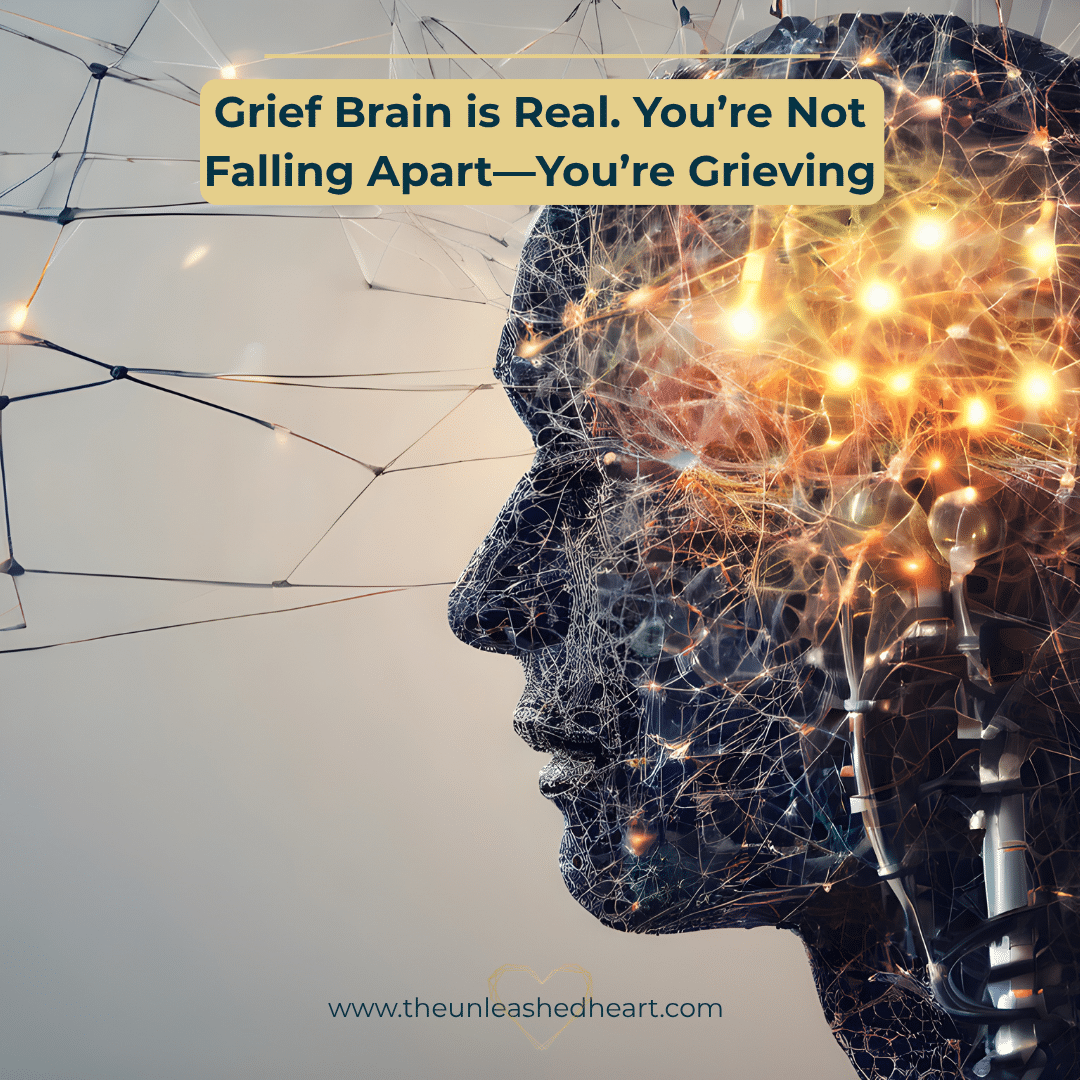
Grief Brain Is Real. You’re Not Falling Apart—You’re Grieving
You walked into a room and forgot why you went in there.
You read the same email three times and still couldn’t tell someone what it said. You said yes to something — a dinner, a meeting, a favor — and have absolutely no memory of agreeing to it.
And then, because that wasn’t enough, you started wondering what’s wrong with you.
Nothing is wrong with you.
Your brain is grieving.
The Fog Has a Name
There’s a reason grief workers talk about “grief brain”—and it’s not a metaphor; it’s physiology.
When you’re in the thick of loss, your nervous system is working overtime. It’s processing something it was never designed to process quickly. The shock, the absence, the way the world looks exactly the same as it did before, even though everything has changed, your brain is trying to make sense of all of it, all at once, all the time.
So yes—the fog is real. The forgetting is real.
This isn’t a weakness. This isn’t you being dramatic. This is what grief does to a human brain, and the fact that nobody told you that ahead of time is one of the quiet cruelties of how we handle loss in this culture.
Here’s what we were taught to do with grief: push through it. Stay busy. Be strong. Get back to normal as fast as possible.
And so that’s what most of us do. We show up to work. We answer the texts. We smile at the right moments. We perform “fine”—not because we are, but because we’ve been taught that falling apart is inconvenient, and that grief has some kind of expiration date we’re already running late on.
But here’s what that performance costs you: energy you don’t have. Mental bandwidth that’s already stretched thin. And, maybe worst of all, the quiet, accumulating shame of feeling like you should be functioning better than you are.
I want to say something directly to that shame: you are not behind. You are grieving.
Grief is the normal and natural response to any kind of loss. Not a disorder. Not a phase to rush through, a response. And responses need space to move through us, not a performance schedule to keep.
What Grief Brain Actually Looks Like
Because I want you to recognize yourself here—not feel more alone—let me name some of what grief brain can look like day to day:
Cognitively: Forgetfulness. Difficulty concentrating. Trouble making even small decisions. Reading the same paragraph four times and retaining nothing.
Emotionally: Numbness that flips without warning into waves of feeling. Irritability that surprises even you. Crying in the car, in the grocery store, in the middle of a sentence.
Physically: Fatigue that sleep doesn’t fix. A heaviness in your chest that shows up before your thoughts do. The body carries what the mind hasn’t fully processed yet.
Socially: Canceling plans and feeling guilty. Showing up and feeling invisible. Saying “I’m fine” so many times, you almost believe it.
If you saw yourself in even one of those, you’re not broken. You’re in the middle of something real.
What Actually Helps (For a Tired, Overwhelmed Nervous System)
I’m not going to give you a ten-step plan. You don’t have the bandwidth for that right now, and honestly, neither does grief.
What I will give you is this:
🛑 Stop adding shame to the fog. The judgment you’re layering on top of the grief is its own weight. You don’t have to earn your way through this. You just have to move through it.
✅ Simplify ruthlessly. What is one thing — just one — that actually needs to happen today? Do that. Everything else is a bonus. Not a failure. A bonus.
🧘 Let your body lead sometimes. Grief lives in the body before it lives in the mind. A walk. A cry you stop trying to hold back. Five minutes of sitting in the sun without your phone. These aren’t indulgences. They’re data collection.
🗣️ Tell someone the truth. Not the “I’m fine” version. The real version. Even once. Even just to one person. One of the most healing things a human being can do is be heard—really heard—without someone trying to fix them.
The One-Thing List
Here’s your small practice for this week, and I mean small:
Write down one thing that needs to happen today. Just one.
Not your to-do list. Not your should list. One thing you can actually do that will move your day forward.
Everything else? Bonus. You did enough just by being here.
Grief brain is one of the reasons the Grief Recovery Method was created the way it was (by a grieving father and Vietnam veteran). Because when you’re in the fog, the last thing you need is someone handing you a complicated roadmap and telling you to figure it out.
What you need is someone who can sit with you in it. Help you make sense of what you’re carrying. Give you tools that work for a tired, overwhelmed, nervous system—not a fully functioning one.
If you’re in that fog right now and you’re wondering whether there’s a way through that doesn’t require you to have it all together first, there is. And I’d love to talk with you about it.
→ Explore grief support options here
→ Book a free consultation — no pressure, no pitch. Just a conversation.
And if you’re not ready for any of that yet, that’s okay, too. Start with the one-thing list. Start with this post. Start with the quiet acknowledgment that what you’re carrying is real, and that you deserve support that meets you where you actually are.
If this landed for you, this blog post goes deeper into what the nervous system carries when relationships add to the weight of grief.

Biofield Tuning, Emotions, Energy, Grief Tips, Growth, Pespective, Reiki |

The Courage to Face Your Pain
When we avoid confronting our emotional pain, it festers inside, creating dis-ease in our bodies and spirits. Healing begins when we stop sweeping pain under the rug and instead sweep our own doorstep. The cyclical patterns that keep us stuck only change when we decide to take responsibility for our healing journey. Your body and feelings serve as guideposts indicating where growth and healing are needed. Unprocessed emotions will eventually find their way out—often in ways we don’t expect or control.
The Inner Work of Emotional Processing
Self-healing resembles peeling an onion—each layer reveals another beneath it. This work requires creating space in your life to process difficult emotions through intentional practices. Grief recovery offers a structured approach to address emotional incompleteness, while energy healing modalities, such as Reiki and Biofield Tuning, provide support exactly where your heart needs it. We transform from emotional storage tanks into emotional processing plants when we learn to sit with our feelings rather than numb them. This inner work enables us to connect past experiences to present behaviors, shifting from a state of survival to one of thriving.
The Freedom Beyond Pain
The most profound freedom comes when we release the prison of our minds. Working through our emotional pain, we discover our ability to be present in relationships without the double message of “get closer but keep your distance.” Our healing radiates outward, positively affecting all our connections. The transformation is remarkable—where once there was heaviness, clarity emerges. Where confusion reigned, purpose develops. The dust begins to settle in all areas of life when we commit to this journey, revealing a life that’s different, better, and more fulfilling than we ever imagined possible.
As a certified grief specialist and energy healing practitioner, I’ve witnessed countless individuals transform through this process. I’ve experienced it myself—moving from being weighed down by unresolved grief to living with purpose and joy. The journey isn’t always easy, but on the other side of pain lies a life of emotional stability, deeper connections, and authentic joy that can only be found by going through rather than around that which causes dis-ease in your body and your life.

Grief Tips, Grieving Voices Podcast, Growth, Healing, Mental Health, Mind/Body Wellness, solo episode |
SHOW NOTES SUMMARY:
Today’s episode is about navigating significant dates and other reminders after a loss. Anniversaries, birthdays, holidays—these milestones can be poignant reminders that reopen the chapters of our grief, not to mention the special places that flood the heart with memories, and then the waves of emotion follow.
But here’s what I’ve learned: While it may seem like these days are there to test our resolve, they also offer us an opportunity for reflection and honoring memories. Consider this—what if you could transform your pain on these dates into acts of remembrance? Lighting a candle or playing their favorite song isn’t just about ritual; it’s about keeping a part of them alive within us.
Key Points Discussed:
- Acknowledging the Weight of Memories
- Permitting Yourself to Feel
- Creating New Traditions
- The Silence Around Grief
- Finding Support That Moves You Forward
- Planning Ahead for Tough Days
- Self-Care & Communication During Grief
When my father passed away, my family chose silence as our coping mechanism—a choice that left little room for healing. It taught me an invaluable lesson: acknowledgment is not only necessary but vital, especially when young eyes are looking up at us to learn how to navigate their own emotional landscapes.
The power of community in times like these cannot be overstated. Surrounding yourself with people who understand your journey is more than comforting; it’s healing. But remember—finding spaces where growth is nurtured over stagnation is crucial. As you approach those tough calendar days, plan ahead. Honor your feelings by allowing yourself to say no when needed and yes to self-care and tenderness towards your heartache.
To everyone walking through seasons of grief: know that every step taken is progress made toward healing—even on those dates marked by absence rather than celebration.
RESOURCES:
_______
NEED HELP?
- National Suicide Prevention Lifeline: 1-800-273-8255
- Crisis Text Line provides free, 24/7 support via text message. Text HOME to 741741 to connect with a trained Crisis Counselor
If you are struggling with grief due to any of the 40+ losses, free resources are available HERE.
CONNECT WITH VICTORIA:
Navigating the Waves of Grief: Honoring Lost Loved Ones on Special Dates
Grief is an unpredictable companion, often intensifying during significant dates that remind us of those we’ve lost. In this episode of *Grieving Voices*, we delve into how these poignant reminders—birthdays, anniversaries, and holidays—can reopen healing wounds and what strategies can help us cope with the renewed sense of loss.
The Ebb and Flow of Memories
Special dates act as powerful triggers for grief. They are stark reminders that life has irrevocably changed. Whether it’s a birthday without the celebrant or a holiday missing one key participant, such days highlight absence with an acute sharpness.
It’s crucial to recognize that feeling overwhelmed by these occasions is not only common but entirely natural. It’s part of the grieving process—one that doesn’t adhere to timelines or expectations. Be gentle with yourself; allow emotions to surface without self-judgment.
Crafting New Traditions in Remembrance
In my own experience following my father’s passing, I learned that ignoring these important dates wasn’t beneficial—for me nor for my siblings who were also grappling with their grief journey. Instead, creating new traditions can be a therapeutic way to honor our loved ones’ memories while acknowledging our ongoing lives.
Lighting a candle might seem simple yet symbolizes so much more—it’s a beacon of remembrance casting light on cherished moments shared together. Playing their favorite music allows melodies to fill the silence left behind—a celebration of their tastes and preferences even in absence.
Cooking a meal they loved serves as an homage through flavors and scents—an intimate connection maintained across different realms. These acts don’t replace presence but rather intertwine memory within current experiences, ensuring our loved ones continue to influence our lives meaningfully.
Seeking Supportive Communities
The importance of finding understanding individuals or groups cannot be overstated when navigating grief’s complexities on special dates. Sharing stories about your loved one can provide immense comfort—not just in expressing your feelings but also in hearing others’ accounts which may echo your own experiences or offer fresh perspectives.
Seek out environments where you feel genuinely heard—a space where progress towards healing is encouraged over stagnation in sorrowful reflection alone.
Preparing for Tough Times
Planning ahead for challenging days involves recognizing personal needs amidst societal expectations surrounding social gatherings and festivities—the right to grieve authentically should always take precedence over conforming to norms if they do not serve your well-being at heart.
Declining invitations needn’t be seen as rudeness but rather an assertion of self-care; prioritize activities conducive to your healing journey whether it means solitude or seeking company depending on what feels right at any given moment.
Healing from loss isn’t passive—it requires openness towards moving forward despite pain lingering beneath surfaces readying itself especially during significant times like anniversaries and holidays.
Taking small steps each day towards acceptance can gradually build resilience against grief’s harsher waves when they come crashing down unexpectedly around these sensitive periods.
As we conclude today’s *Grieving Voices* discussion remember: care deeply for yourselves because through unleashing hearts comes freedom—and ultimately life itself becomes unleashed anew albeit differently shaped by love enduring beyond physical presence alone.
Until next time cherish every heartbeat knowing each throb honors those gone before us guiding lights forevermore along paths trodden under starlit skies filled with memories everlasting… Much love always 💖
Episode Transcription:
Victoria Volk: Welcome dear listeners to another episode of our journey together through grief and healing on this episode, one ninety, holy cow of grieving voices. So thank you so much for being here.
Victoria Volk: Today, I’m addressing a topic that touches the heart deeply, navigating special dates and reminders after the loss of a loved one. Whether it’s the anniversary of their passing, their birthday, or the first holiday season without them. These moments can reopen wounds and challenger peace, quite frankly. Let’s start by acknowledging that these dates and reminders like the empty chair at the holiday table or the quiet of a bedroom once filled with laughter. Carry a weight of memories and emotions. And it’s entirely okay to feel a surge of grief, and it’s okay to seek ways to honor and remember those we’ve lost while nurturing our hearts. Firstly, I want to tell you, give yourself permission to feel. I didn’t for over thirty years. And that’s a form of suffering. That’s a form of self suffering. Grief doesn’t follow a schedule and emotions may come in waves. It’s important to allow yourself to experience these feelings without judgment. I can tell you, I wish I would have allowed myself to feel much sooner and earlier in my life.
Victoria Volk: Creating a new tradition can be a meaningful way to honor your loved one. Light a candle for them. Play their favorite music, or prepare a meal they loved. This act of remembrance can be a comforting way to keep their memory alive. I remember when my dad passed away and on the anniversaries, there was no talk of remembrance or honoring quite frankly, it was not even really acknowledged. It was something that we held closely to the vest individually. And that’s really sad to me. And I don’t wish that for anybody, especially children who grow up learning that that’s the air quote, right way to grieve. There is no right or wrong way to grieve. There’s your way, but there are healthier, more proactive ways. That move you forward, but don’t keep you stuck. That’s what I’m all about. And so in order to do that, Oftentimes we need to reach out to for support. Surrounding yourself with understanding, friends, or family, or even joining a support group. Be careful though. Support groups can be a place that make you feel more miserable after you leave.
Victoria Volk: So it’s important to find a support group that you feel comfortable with, that everyone’s voice feels heard and honored, and quite frankly, that maybe has some action that moves you forward, not keeping repeating the same story week after week. But it can be a great place to connect with other people who have experienced a similar loss as you. And even if they haven’t experienced a similar loss as you, we can all learn something from each other. But spaces like these and people that we trust can often provide us comfort It enables us to share stories and memories which can be powerful way to feel connected to your loved one and to others who understand your pain. Again, this wasn’t something that was demonstrated for me growing up as a child. And I don’t think that is the case for many children, even today, I don’t think much has changed in in the ways that we grieve. Which is why my mission to share what grief is and my understanding, my new understanding, my new knowledge, what I’ve learned about it, has become an important mission of mine.
Victoria Volk: So thank you for joining me in this episode, and I hope that you share it. And share any other episode that you feel could be insightful or helpful to someone else you know or love. Coming back to the episode and what we’re talking about today, it’s important to plan ahead for those tough days. Knowing that a difficult date is approaching, consider planning a day that balances remembrance with self care. It might be a day for quiet reflection or doing something that brings you joy or peace. I recently had the deversary of my father. And quite frankly, I spent the day doing what I love. And that’s putting together and working on a pet loss program. And working on my mission, that was a way that I could honor my loss. In the memory of my father. And so whatever that means for you, that is a form of self care.
Victoria Volk: Moving on for those reminders that come unexpectedly, like an invite to an event your loved one will never experience. Like a wedding, graduation, baby shower. It’s okay to give yourself grace. It’s okay to decline invitations if you’re not ready. And it’s okay to take moments for yourself when memories flood in unexpectedly. Perhaps you wish to attend these events, and create an exit strategy for yourself if it becomes too much and emotionally overwhelming. One more thing on that note, if it’s been several years. Now again, grief doesn’t follow a timeline. If moving forward and being able to go to events like a wedding or a baby shower or graduation is something you want to do without feeling this pull to the pain of the past? That is an indicator for you, that it’s time to take action, that it’s time to address what is emotionally incomplete for you.
Victoria Volk: And I’ve shared it in other podcast episodes, and I’ll share it today. I do have a program that’s one on one working with Grievers. Twelve sessions. It’s called do grief differently. It’s just you and me. It’s not talk therapy. It’s an evidence based program that is specific to you and your life experience and your specific grief. And that’s why it works. It may appear to be like this cookie cutter thing. And I know a lot of people might think, well, it worked for you who you know, it’s not gonna work for me. How do you know unless you try? And if you tried everything else, what do you have to lose? But more years of a joy filled life. That’s my challenge for you today as you’re listening to this, to consider that. Moving on to my final recommendation for Grievers listening to this. Is consider creating a memory box or a dedicated space in your home where you can display photos, momentos, or anything else that reminds you of your loved one.
Victoria Volk: Visiting the space can offer a sense of closeness and a personal sanctuary for your grief and love. There is a caveat to this though. Sometimes we can enshrine people. We can create an enshrinement in our homes. Of the person we we lost. And these enshrinements where we view the person as never having any humanness to them, like never having any faults, never doing anything bad and we just we we think only the positive about this person. But if you really dig deep, You have to ask yourself, how true is that? Because even the closest people we we love who have passed away, hurt us in some way, caused us suffering or pain, or stress or frustration, maybe we were estranged. We need to get to the emotional truth of the relationship and if we entrying people. And never become emotionally complete with those those hertz that we’re holding on to. But we’re over shrouding and over simplifying and probably even minimizing or not even addressing the other things that hurt us. This is where we remain emotionally incomplete. And remain stuck in our pain.
Victoria Volk: So it’s important to consider that when you’re creating this space in your home for someone who is passed away. On the flip side of that, we also call the opposite, be devilment, where you only think of the negative about somebody or only hold on to the negative aspects of the relationship. And you have to ask yourself that as well. Like, is that completely true? Is that one hundred percent true of the relationship? Relationships are dynamic and complicated and complex and layered and and we have to address all of the emotional stuff on the positive and the negative side to become emotionally and we can’t do that if we’d be devolving someone or if we’re enshrining the relationship. And maybe that’s the first time you’ve heard any of that.
Victoria Volk: And Maybe you’re asking yourself, oh, do I have an enshrinement? It might be devilish someone in a relationship, and only you can answer that. But take some time with this episode and reflect on the things that I’ve shared so far. Listen to it again if you have to. But remember, dear listeners grief is a journey that is uniquely yours. And there’s no right or wrong way to navigate these moments when they hit. But I wanted to share this episode as a way to support and bring some lightness to the dark, and to let you know that it’s okay to have days where you don’t feel okay. And being able to communicate that to those around you saying, you know what, I need space today. Thank you so much for the invitation, but I’m going to have to decline. That’s all you need to say. You don’t need to go into the long story, an explanation. You don’t owe an explanation. Just I need to tend to my heart today. That’s it.
Victoria Volk: And so what’s most important is that you do what feels right for you allowing yourself to heal. Again, allowing yourself to heal. You have to be open to receiving that healing. And I also think you need to be ready to want to heal. And remember in your own time and in your own way that will happen. Might not be today, but hold the hope that it could be tomorrow or even two months from now. If you take little baby steps every day, I promise you you’ll get there, but Time is not gonna wait for you to figure it out. Didn’t wait for me. Over thirty years, it did not wait for me. Trust me on that. It takes action to move your life forward in the direction that you want it to go. Thank you for sharing this time with me today. May you find comfort and strength and healing in the days ahead?
Victoria Volk: Until next time, take care of your hearts. And remember, when you unleash your heart, you unleash your life. Much love.
